 comparison
Is Self-Paced Learning Better? A 2026 Guide
Table of Contents
- What Makes Self-Paced Learning Different
- Self-Paced vs Instructor-Led Learning: A Direct Comparison
- The Real Challenges of Independent Study
- How to Track Student Progress in a Self-Paced Model
- The Hybrid Middle Ground: Blending Both Approaches
- Is Self-Paced Learning Better for Your Child?
- Frequently Asked Questions
Last Updated: September 7, 2026
What Makes Self-Paced Learning Different
Self-paced learning is an educational approach where students control the speed, timing, and sequence of their instruction rather than following a fixed class schedule. This model replaces the traditional teacher-led classroom rhythm with asynchronous learning, allowing children to move through material only when they demonstrate mastery. At IQ Learning Australia PTY LTD, this format can transform how Australian families approach homeschooling, shifting the parent's role from lecturer to learning manager.
The distinction matters because it changes who owns the learning. In a conventional classroom, the teacher sets the pace for thirty students at once. Self-paced learning hands that control to the individual child, which sounds ideal in theory and often works brilliantly in practice. However, the same autonomy that makes self-paced learning attractive also creates the conditions where it can fail, which is precisely what most promotional material overlooks.
Before choosing this path, parents need a clear-eyed view of what self-paced learning actually demands. It is not an easier version of school. It is a different structure entirely, one that requires deliberate planning around curriculum design, progress tracking, and accountability systems that a classroom teacher would normally provide.
Self-Paced vs Instructor-Led Learning: A Direct Comparison
The core question most parents ask is straightforward: which format produces better educational outcomes? The honest answer is that neither approach is inherently superior, because each suits different children, subjects, and family circumstances.
Instructor-led training provides external structure, immediate feedback, and social accountability. Self-paced learning offers flexibility, personalisation, and the chance to develop genuine autonomy. The table below summarises how they differ across the factors that matter most to homeschooling families.
| Factor | Self-Paced Learning | Instructor-Led Learning |
|---|---|---|
| Schedule control | Full flexibility | Fixed timetable |
| Learner agency | High, student directs pace | Low, teacher directs pace |
| Knowledge retention | Strong when mastery-based | Varies with class size |
| Accountability | Requires external systems | Built into classroom |
| Cost | Varies | Varies |
| Best for | Motivated, independent learners | Students needing structure |
Flexibility and Learner Agency
The defining advantage of self-paced learning is the personalised learning path it creates. A child who grasps fractions quickly can move to decimals the same week, while one who struggles can revisit foundational concepts without holding back peers or feeling left behind. This flexibility directly addresses the reality that children learn at different speeds across different subjects (apa.org).
Learner agency is the psychological engine here. When a student controls their learning pace, they develop ownership over the process, which research in educational psychology links to stronger intrinsic motivation. The key is that pacing must be genuine, not just a slower version of the same curriculum. True self-pacing lets a child accelerate in strengths and decelerate in weaknesses simultaneously.
Knowledge Retention and Accountability
Where self-paced learning often stumbles is accountability. External deadlines and teacher oversight are powerful motivators, and removing them can reduce follow-through. Knowledge retention suffers when students skim material without formative assessment to confirm understanding.
The solution is structured self-pacing, where progress is gated by demonstrated mastery rather than time spent. Interactive modules, regular quizzes, and clear learning checkpoints convert passive video watching into active skill acquisition. Without these structures, self-paced learning becomes self-directed study in name only, and completion rates drop noticeably.
The Real Challenges of Independent Study
The most significant barrier to successful self-paced learning is psychological, not academic. While the benefits of autonomy are well documented, the cognitive and emotional load of managing that autonomy is rarely discussed. This section addresses the specific psychological barriers, procrastination, the 'lonely learner' syndrome, and motivation collapse, and offers concrete strategies to counter them.
Procrastination and the Planning Fallacy
Without external deadlines, many students fall victim to the planning fallacy: the tendency to underestimate how long a task will take, leading to a compressed panic before assessment (wikipedia.org). This is not a character flaw; it is a well-documented cognitive bias. In a classroom, the teacher's schedule compensates for this bias. In a self-paced model, the student must develop the metacognitive skill of accurate time estimation, which is rarely taught explicitly.
A common pattern is that students initially overestimate their capacity, then experience a motivation collapse when they fall behind their own schedule. This creates a shame spiral that further reduces engagement. Parents often underestimate how much their presence substitutes for classroom structure. A common mistake is assuming a child who thrives with teacher direction will automatically manage independent study.
Practical countermeasures:
- Time-boxing, not task-listing: Instead of 'finish Module 3,' schedule '45 minutes on Module 3, twice daily.' This makes progress visible and reduces the overwhelm of open-ended tasks.
- Implementation intentions: Have the child state 'When I finish breakfast, I will start my maths lesson.' This links the task to an existing routine, bypassing the need for daily motivation.
- Weekly planning sessions: Spend 15 minutes each Sunday mapping the week's targets. This shifts the parent's role from nagging to coaching.
The 'Lonely Learner' Syndrome and Cognitive Load
Self-paced learning fails when it becomes isolated learning. Students who never interact with instructors or peers lose access to immediate clarification and the social dimension of education. Extended periods without feedback allow misconceptions to solidify, and these errors are harder to correct later than they would be in an instructor-led setting.
This isolation also increases cognitive load. In a live class, a teacher provides real-time scaffolding, clarifying instructions, breaking down complex problems, and offering worked examples. In a self-paced environment, the student must hold the entire problem space in working memory without that external support. This is why many students report feeling more mentally exhausted after an hour of self-paced study than after a full day of school.
The role of the parent as 'cognitive coach':
Parents can mitigate this by adopting a 'cognitive coaching' stance rather than a purely supervisory one. This means:
- Asking process questions: Instead of 'Did you finish?', ask 'What was the hardest part, and how did you work through it?'
- Scheduled 'confusion check-ins': Rather than waiting for the child to ask for help (which many avoid), schedule a brief daily check-in specifically to surface questions.
- Encouraging 'teach-back': Have the child explain a concept they just learned. This forces retrieval and reveals gaps in understanding that passive review misses.
When Self-Pacing Fails: The Scaffolding Gap
Another failure point is pacing that is too loose. Children who lack time management skills often need scaffolding, such as weekly targets or scheduled check-ins, before they can handle fully open-ended timelines. Digital literacy also matters; younger students may struggle with the interface demands of a learning management system, creating frustration that has nothing to do with the subject matter.
Research on cognitive load theory suggests that the brain prefers autonomy only when the task itself is within the learner's zone of proximal development. When the task is too difficult, autonomy becomes a burden, not a benefit. This is why a 'one-size-fits-all' self-paced approach fails for many students, it assumes the learner already possesses the executive function skills that the format itself is supposed to develop.
The Motivation Curve: Why Enthusiasm Fades
Motivation in self-paced learning typically follows a predictable curve: high enthusiasm in the first two weeks, a dip in weeks three to six, and either recovery or abandonment by week eight (researchgate.net). This curve is rarely discussed in promotional material, yet it is the single most common reason families abandon self-paced programs.
The dip is not a sign of failure; it is the point where novelty wears off and the work becomes routine. Parents who anticipate this dip can plan for it, by introducing a new reward structure, changing the learning environment, or scheduling a live tutoring session to re-engage the child. Without this anticipation, the dip is often misinterpreted as evidence that the child 'isn't suited' to self-paced learning, when in fact the structure simply needs adjustment.
How to Track Student Progress in a Self-Paced Model
Tracking progress in a self-paced environment requires shifting from time-based metrics to mastery-based ones. Instead of asking 'how many pages did we cover this week,' ask 'which skills has my child demonstrated mastery of.' This distinction is the heart of effective progress monitoring.
But tracking progress is only half the challenge. The deeper question, one that few resources address, is how to validate that learning has actually occurred when there is no instructor to assess it. In a traditional classroom, the teacher's professional judgment provides external validation. In a self-paced model, parents must build a validation framework that proves mastery without relying on a single test score.
The Mastery Validation Framework
A robust validation system combines three distinct types of evidence:
-
Formative evidence, Regular quizzes and interactive exercises that confirm understanding before moving forward. These should be low-stakes and frequent, designed to identify gaps rather than grade performance.
-
Performance evidence, A portfolio of work products: written explanations, solved problems, recorded oral explanations, or projects. This is the most reliable proof of mastery because it demonstrates application, not just recognition.
-
Delayed recall evidence, Periodic summative evaluation that validates learning has been retained over weeks, not just memorised overnight. A quiz on last month's material, administered without warning, is the strongest test of genuine retention.
Self-Assessment Tools That Actually Work
Most self-paced platforms include quizzes, but quizzes alone are insufficient. They measure recognition, not recall. To build a complete validation system, parents should incorporate:
-
Rubric-based self-assessment: Have the child score their own work against a simple rubric (e.g., 'Did I show all working steps? Did I check my answer?'). This develops metacognition and reduces the parent's burden as sole judge.
-
The 'teach-back' method: Ask the child to teach a concept to you, a sibling, or even a stuffed animal. If they can explain it coherently without notes, they have likely mastered it. This is a form of retrieval practice with strong evidence behind it.
-
Error analysis logs: When a child gets a question wrong, have them log the error type (misunderstanding, careless mistake, or knowledge gap). Over time, this reveals patterns that a simple percentage score obscures.
Building a Progress Dashboard Without the Admin Overload
Parents without a teaching background often struggle to build these systems manually. A practical system combines three elements: formative assessment through regular quizzes, performance metrics showing completion rates and accuracy trends, and periodic summative evaluation. The challenge is that manual tracking becomes unsustainable beyond one or two subjects.
This is where a structured platform becomes valuable. IQ Learning Australia PTY LTD provides learning analytics and progress tracking that automatically record quiz results, lesson completion, and skill mastery, replacing the manual spreadsheet approach with a dashboard designed for parents. The platform's separate parent and child access paths mean students see their next lesson while parents see the bigger picture of what has been mastered and what needs attention.
The 'Proof of Learning' Conversation
For families using self-paced learning within a homeschooling registration framework, validation takes on additional importance. Most Australian state and territory regulators require evidence of educational progress. A self-paced model that relies solely on platform quizzes may not satisfy these requirements.
A practical approach is to maintain a learning portfolio that includes:
- Monthly work samples across each subject
- A log of completed modules with dates and quiz scores
- Written reflections from the child about what they learned
- Records of any external assessments (e.g., standardised tests or competitions)
This portfolio serves a dual purpose: it provides evidence for regulatory requirements, and it gives the child a tangible record of achievement that builds confidence. The act of curating a portfolio is itself a learning activity, reinforcing the connection between effort and outcome.
The Hybrid Middle Ground: Blending Both Approaches
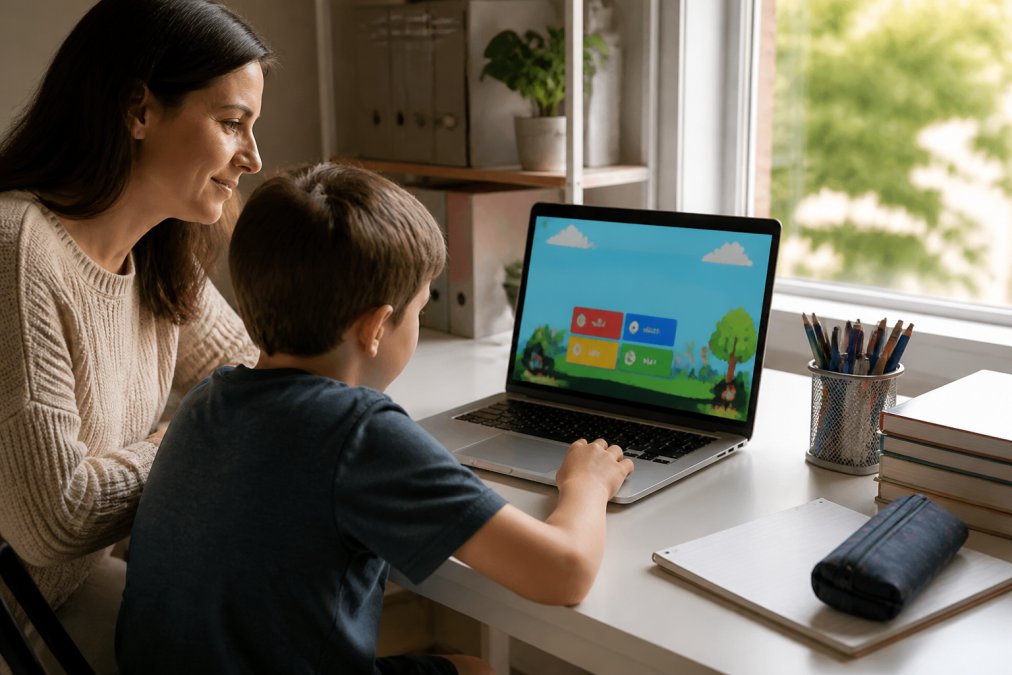
The most effective model for many families is not a choice between self-paced and instructor-led learning, but a deliberate blend of both. Hybrid learning combines the flexibility of self-paced modules with scheduled live sessions, tutoring, or co-op classes that provide external accountability and social interaction.
This blended approach addresses the weaknesses of each format. Self-paced components handle content delivery and skill practice, while instructor-led sessions provide clarification, discussion, and the human connection that keeps students engaged. For homeschooling families, this might mean video lessons and quizzes during the week, with a weekly online class or local group session for collaborative work.
The practical benefit is resilience. If a child falls behind in self-paced work, the scheduled live session acts as a safety net, prompting catch-up before gaps widen. Conversely, if a live class moves too slowly, the self-paced component lets the child push ahead. Blended learning models recognise that most students need both autonomy and structure, just in different proportions at different times.
Is Self-Paced Learning Better for Your Child?
Self-paced learning is better for children who show curiosity, can sustain focus on tasks they find engaging, and respond well to having control over their schedule. It suits families where a parent can commit to daily oversight and where the curriculum can adapt to the child's natural rhythm rather than forcing the child to fit a rigid timetable.
Self-paced learning is a poor fit when a child requires strong external motivation, when the parent cannot provide consistent accountability, or when the subject matter benefits from live discussion and immediate feedback. It also struggles for younger children who lack the digital literacy and reading stamina that independent online work demands.
Consider your child's study habits honestly. A student who already manages homework without reminders, asks questions when confused, and shows persistence through difficulty will likely thrive. A student who avoids challenging work, needs constant prompting, or becomes frustrated without immediate help may need more instructor-led structure, at least initially. Many families find that a hybrid approach works best during the transition, gradually increasing self-pacing as the child's skills develop.
The deciding factor is not the format itself, but the match between the format and your child's needs. Self-paced learning rewards families who invest in the right supporting structures, particularly around progress tracking and accountability. For parents seeking those structures, IQ Learning Australia PTY LTD combines AI-powered educational content, interactive quizzes, and personalised learning plans into a single platform.
Choosing between self-paced and instructor-led learning is one of the most significant decisions you will make for your child's education. The right answer depends on your child's temperament, your availability as a learning partner, and the quality of the tracking systems you put in place. A self-paced model without accountability will disappoint, while a structured one can unlock genuine autonomy and love of learning. IQ Learning Australia PTY LTD supports this balance with personalised learning plans, learning analytics, and video lessons designed for the Australian curriculum. Explore how the platform can support your homeschooling journey and give your child an education tailored to their pace and potential.
Frequently Asked Questions
Is self-paced learning effective for primary and secondary students?
Self-paced learning can be highly effective for primary and secondary students when the content is structured and progress is monitored. Young learners often thrive when they can move quickly through topics they grasp easily and spend more time on challenging material. However, effectiveness drops without external accountability. Parents need to establish a routine, check in regularly, and use a platform that tracks mastery rather than just completion. Research shows that combining self-paced modules with periodic instructor or parent-led check-ins produces the strongest educational outcomes for school-aged children.
What are the main disadvantages of self-paced learning?
The main disadvantages of self-paced learning centre on motivation and isolation. Many students struggle with procrastination when deadlines are flexible, and completion rates for purely self-paced courses are often low. Learners also miss the immediate feedback and spontaneous questions that instructor-led sessions provide. Without a teacher to clarify misconceptions quickly, students may practise incorrect methods. Social isolation can reduce engagement, particularly for younger learners. These challenges of independent study are manageable with the right structure, but they require deliberate planning from parents or educators to overcome.
How does self-paced learning compare to traditional classroom instruction for knowledge retention?
Self-paced learning supports knowledge retention when learners have high intrinsic motivation and can control their cognitive load by pausing and reviewing material. Traditional classroom instruction offers real-time clarification and social reinforcement, which helps learners who need immediate feedback. The strongest approach combines both: self-paced study for initial content acquisition, followed by instructor-led sessions for discussion, application, and summative assessment. This blended model leverages the flexibility of self-paced learning while maintaining the accountability and interaction of a classroom, leading to better long-term retention than either format alone.
What support systems are needed for successful self-paced learning?
Successful self-paced learning requires more than just quality content. A reliable learning management system with clear progress tracking is essential. Learners need a structured schedule with milestones to prevent procrastination. Access to a mentor, parent, or instructor for periodic check-ins provides accountability and helps address misunderstandings early. Peer interaction, even through online forums, reduces isolation and maintains engagement. Parents should also establish a dedicated study space and routine. Platforms that offer AI-powered analytics help identify learning gaps early, allowing parents to intervene before minor confusion becomes a major barrier.