 how-to
Homeschooling Curriculum for Visual Learners: A 2026 Guide
Table of Contents
- Understanding Visual Learners and Their Curriculum Needs
- How to Teach a Visual Learner at Home
- Homeschool Maths Curriculum for Visual Learners
- Visual Learning Activities for Homeschool
- Online Homeschool Programmes for Visual Learners
- Implementing a Homeschool Curriculum: Sample Weekly Schedule and Measuring Progress
- Common Mistakes to Avoid When Selecting a Curriculum
- References & Further Reading
- Frequently Asked Questions
Last Updated: October 18, 2026
Understanding Visual Learners and Their Curriculum Needs
Visual learners process information most effectively through seeing and observing. They think in pictures and perform better when lessons include diagrams, charts, colour coding, and visual demonstrations rather than text alone.
At IQ Learning Australia PTY LTD, we've seen many parents underestimate how differently visual learners absorb material. Matched with the right homeschooling curriculum for visual learners, this preference transforms engagement and retention.
Visual learners often doodle during explanations, remember faces better than names, and prefer maps to written directions.
What visual learners are and how they learn
Visual learners process the world through images, spatial relationships, and visual patterns. They benefit most from homeschooling curriculum for visual learners with video lessons, diagrams, colour-coded systems, and graphic organisers, and they remember history through timelines and maps.
A visual learner given only written instructions may feel lost, yet the same learner shown a video or step-by-step diagram typically grasps the concept immediately.
Identifying your child's visual learning preferences
Identifying a visual learner requires observation rather than testing. Watch for these signals: does your child ask "Can you show me?" more than "Can you explain?", sketch while thinking, or remember what they've seen but forget what they've heard?
A practical approach: teach the same concept three ways over a week, verbally, through reading, and through a visual demonstration, then track which method your child engages with longest and recalls most accurately a few days later.
How to Teach a Visual Learner at Home
Creating an environment where visual learners thrive requires intentional choices about space, materials, and instructional methods.
Creating a visual-friendly learning environment
A visual-friendly learning environment prioritises clarity, colour, and visual organisation.
Natural light reduces eye strain, and a sparse, organised space helps visual learners focus, too many competing items cause overwhelm.
Use colour strategically: maths in blue, English in green, science in yellow. This coding helps your child locate materials quickly and mentally organise information by subject.
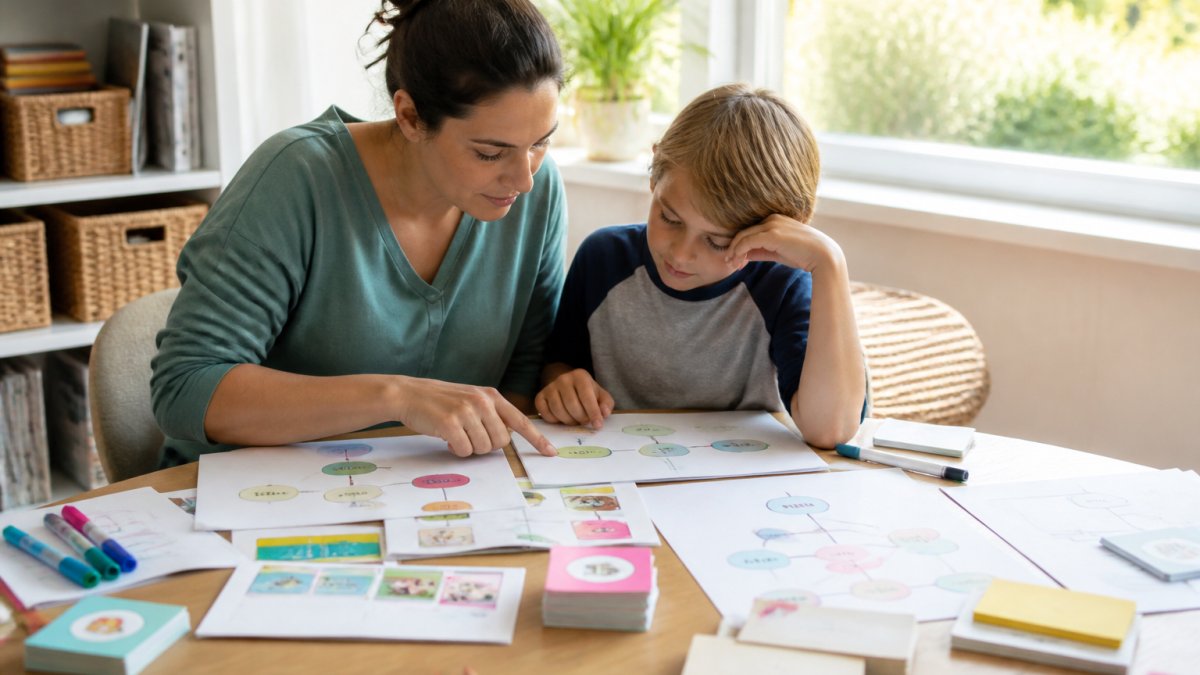
Using maps, diagrams, charts, and graphic organisers
Maps, diagrams, and charts transform abstract information into concrete visual forms: maps for geography, flowcharts for processes, Venn diagrams for comparing concepts.
Graphic organisers, structured templates for organising information visually, are particularly powerful: a mind map shows how ideas connect, a timeline shows sequence, and a concept map displays relationships between topics.
Encourage your child to create their own diagrams and charts.
Homeschool Maths Curriculum for Visual Learners
Maths is where visual learning makes the most dramatic difference. Traditional maths teaching relies on abstract symbols and written procedures, and visual learners struggle not because they lack ability but because the presentation doesn't match how they think.
Why traditional maths teaching fails visual learners
Traditional maths instruction, explain a procedure verbally, show worked examples, assign practice problems, misses the most critical step for visual learners: showing why the procedure works visually.
A visual learner may struggle with "5 + 3 = 8" written abstractly but immediately grasp it when shown five objects plus three arranged visually.
When maths curriculum skips visual representation and jumps straight to symbols, visual learners memorise procedures without understanding them, leading to errors when the problem structure changes slightly.
Manipulatives, colour coding, and visual number strategies
Manipulatives are essential for visual learners: base-ten blocks make place value tangible, fraction circles show how parts relate to wholes, and algebra tiles visualise equations.
Visual number strategies replace abstract procedures with visual thinking: show "borrowing" in subtraction by regrouping ten ones into one ten, and show long division as a visual partition of the dividend into groups.
Visual Learning Activities for Homeschool
Beyond curriculum selection, specific activities reinforce visual learning and maintain engagement across subjects and age levels.
Video lessons and visual demonstrations
Video lessons are powerful because they combine movement, visual demonstration, and narrative.
Select videos that prioritise visual demonstration over voiceover narration: one showing processes, transformations, and visual relationships beats a presenter talking to camera.
Live demonstrations are equally powerful: show water freezing, melting, and evaporating for states of matter, or drop objects of different weights to show gravity acting equally. These create lasting mental images.
Flashcards, doodling, drawing, and hands-on projects
Flashcards work well for visual learners when they include visual elements beyond text, a small diagram, colour-coded clue, or visual representation alongside the word or concept.
Encourage doodling and drawing as learning tools, not distractions. A child who draws a water cycle diagram while learning about it is processing information visually and engaging in active learning.
Hands-on projects combine visual, kinesthetic, and tactile learning.
Online Homeschool Programmes for Visual Learners
Selecting an online homeschool programme for visual learners requires evaluating specific features and formats. Not all digital curricula are equally visual.
What to look for in a digital curriculum
Look for platforms with interactive visual elements, not just static text: animations that show processes, interactive diagrams students can manipulate, and visual progress tracking all support visual learners.
Consider the assessment format too. Multiple-choice questions with visual options, diagram-labelling tasks, and visual matching exercises assess visual learners more fairly than text-only questions.
Curriculum selection by subject, grade, and format
Different subjects benefit from different visual approaches. For homeschool maths curriculum for visual learners, prioritise platforms offering manipulatives, visual number strategies, and colour-coded systems.
Grade level affects curriculum selection. Primary-level visual learners benefit from heavily visual, hands-on curricula with minimal text.
Format matters significantly. Some programmes are entirely video-based, others combine video with interactive elements, and still others are primarily text-based with visual supplements.
Budget and free or low-cost resources
Quality visual learning resources exist across all price points. Free resources include Khan Academy (video lessons with visual demonstrations), YouTube educational channels, and open-source graphic organiser templates.
Low-cost resources include platforms offering free trials or freemium models. Explore these trial periods thoroughly, they reveal whether the platform's visual approach matches your child's learning style.
Paid platforms range widely in cost. Many offer monthly subscriptions rather than annual commitments, reducing financial risk while you evaluate fit.
Implementing a Homeschool Curriculum: Sample Weekly Schedule and Measuring Progress
Selecting a curriculum is one step; implementing it consistently is another. A realistic schedule and clear progress tracking determine whether your chosen curriculum actually works for your child.
Building a realistic weekly routine
A realistic weekly routine balances structured learning time with flexibility.
Build in visual breaks. After 45 minutes of focused work, a 10-minute break where your child sketches, organises their materials, or reviews visual notes helps them reset, processing time that supports visual learners.
Include dedicated time for visual learning activities: creating diagrams, making flashcards, working with manipulatives, watching demonstration videos, and completing hands-on projects. These are core learning methods for visual learners, not supplements.
Tracking comprehension and retention
Visual learners show comprehension differently than other learners. They may demonstrate understanding through diagrams, sketches, or visual explanations rather than written responses, so traditional tests often underestimate them.
Track comprehension through multiple methods: Can your child explain a concept using a diagram they've created? Can they apply the concept to a new problem?
Retention improves when visual learners regularly review material visually.
Keep a visual record of progress.
Common Mistakes to Avoid When Selecting a Curriculum
Several predictable mistakes derail curriculum selection for visual learners.
Treating visual learning as fixed rather than contextual is a common error.
Assuming more visual content is always better leads to overwhelm.
Neglecting to transition gradually from concrete visual supports to more abstract representation is another mistake.
Selecting a curriculum based on marketing rather than actual visual content is surprisingly common.
Homeschooling a visual learner requires matching your curriculum to how your child actually processes information. The most effective approach combines a homeschooling curriculum for visual learners that prioritises diagrams, video, colour coding, and manipulatives with a learning environment designed for visual thinking and regular progress tracking based on visual demonstrations of understanding.
At IQ Learning Australia PTY LTD, we've built our platform specifically for this challenge.
References & Further Reading
According to research on learning modalities from the University of New South Wales, understanding how individual students process information is foundational to effective teaching.
The Australian Curriculum, Assessment and Reporting Authority guidance on differentiation emphasises that curriculum implementation must account for diverse learner needs and preferences.
Research from learning sciences literature on visual-spatial reasoning demonstrates that visual representation significantly improves comprehension and retention for students who process information visually.
| Curriculum Feature | Why It Matters for Visual Learners | Implementation Example |
|---|---|---|
| Video lessons | Demonstrates concepts in motion | Chemistry experiment shown step-by-step |
| Manipulatives | Makes abstract concepts concrete | Base-ten blocks for place value |
| Colour coding | Organises information visually | Different colours for different subjects |
| Graphic organisers | Structures visual thinking | Mind maps for brainstorming |
| Diagrams & charts | Shows relationships and processes | Timeline of historical events |
| Hands-on projects | Combines visual, kinesthetic learning | Building 3D models of concepts |
Frequently Asked Questions
How can I tell if my child is a visual learner?
Visual learners typically prefer pictures, diagrams, and colour-coded notes over written text or verbal instructions. Watch whether your child remembers things they've seen more easily than things they've heard, if they doodle while learning, or if they ask for written directions rather than verbal ones. They often organise information spatially and respond well to charts and maps. Not all children fit neatly into one learning style, so observe their strengths across different subjects and activities rather than treating learning preferences as fixed labels.
What should you look for in a homeschooling curriculum for a visual learner?
Prioritise curricula that include video lessons, interactive diagrams, colour-coded examples, and graphic organisers rather than text-heavy workbooks. Check whether the programme uses visual demonstrations for abstract concepts, especially in maths and science. Look for platforms that combine written instructions with visual supports, offer progress tracking dashboards so you can monitor comprehension, and allow you to adapt lessons with your own visual aids. Ensure the curriculum supports multisensory learning, pairing visuals with hands-on activities, rather than relying solely on screens.
Are online homeschool programmes effective for visual learners?
Online programmes can be highly effective for visual learners when they prioritise video content, interactive visuals, and adaptive learning. Many digital platforms track which concepts your child struggles with and adjust difficulty accordingly, giving you real-time insight into learning gaps. However, effectiveness depends on the specific programme's design and your child's engagement. The best results come from combining online lessons with hands-on activities, flashcards, and real-world visual examples rather than relying on screens alone. Test a trial or free tier before committing to a full subscription.
How do I adapt a homeschool curriculum to include more visual resources if the programme doesn't provide them?
Supplement text-based lessons with free visual tools: create colour-coded notes, use graphic organisers to map concepts, and draw diagrams to explain processes. For maths, introduce manipulatives like blocks or counters to make abstract ideas concrete. Search YouTube for educational videos that explain the same topic visually. Use flashcard apps with images, create mind maps for complex topics, and encourage your child to illustrate their learning. Many free resources exist through educational websites and apps, you don't need to purchase additional subscriptions to add visual depth to any curriculum.